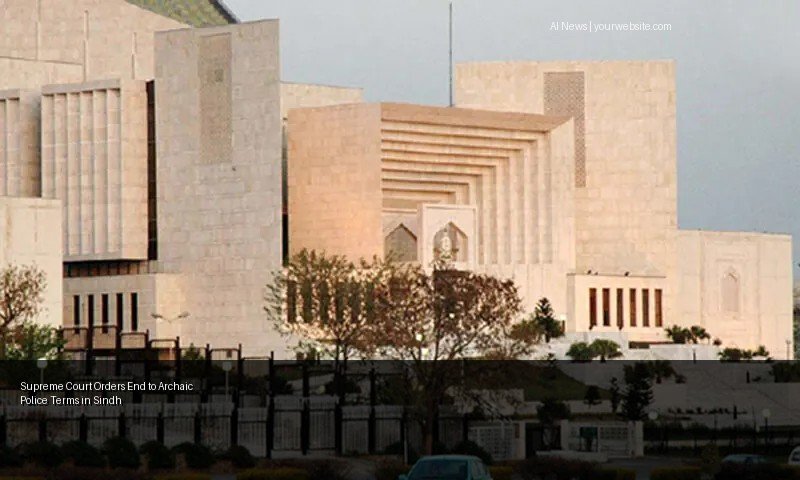
The Supreme Court of Pakistan has taken a significant step towards modernizing police procedures in the province of Sindh by ordering the discontinuation of archaic expressions commonly used in official communications.
The court held that terms such as Bakhidmat Janaab SHO have no legal status and reflect a colonial mindset, where citizens approach authorities as a matter of mercy rather than as a right.
As per the court’s ruling, the term Bakhidmat Janaab SHO incorrectly implies that the citizen is at the service of the station house officer, whereas in fact, the SHO is at the service of the citizen.
The court further observed that the use of such terminology undermines the dignity of the citizen, which is inviolable under Article 14 of the Constitution, and weakens the concept of equal protection under the law.
Authored by Justice Salahuddin Panwhar, the court noted the use of expressions such as Bakhidmat Janaab SHO, as well as Faryaadi and Muddai, in police proceedings and ordered that police practices be brought in line with Articles 4, 9, 10-A, and 14 of the Constitution.
The court stated that the use of the terms Faryaadi or Muddai in police proceedings should be discontinued and appropriate and legally accurate alternatives should be used, including Itlaah Deendhar or Shikayat Kandhar in Sindhi, and Itlaah Dahinda in Urdu.
Justice Panwhar observed that police officers are public servants entrusted with constitutional and statutory duties and that they are bound to protect life, liberty, and the security of person, values at the core of Article 9 of the Constitution.
“Police officers are required to serve the citizens as they are remunerated from public funds. Citizens approach the police as a matter of right, not as a charity grace or indulgence. Any institutional practice that reverses this relationship erodes public confidence in the rule of law and weakens constitutional governance,” the verdict read.
The SC noted that the continued use of Faryaadi reflected an outdated and unconstitutional mindset, in which public authorities were seen as rulers rather than servants of the people — a notion explicitly rejected by the Constitution.
It continued that expressions such as Faryaadi and formulaic salutations like Bakhidmat Janaab SHO were remnants of a colonial and pre-constitutional paradigm.
Published in Dawn, January 31st, 2026
Disclaimer: This content is AI-generated for informational purposes.
Original Source: Dawn
For more updates, visit: YourWebsite.com